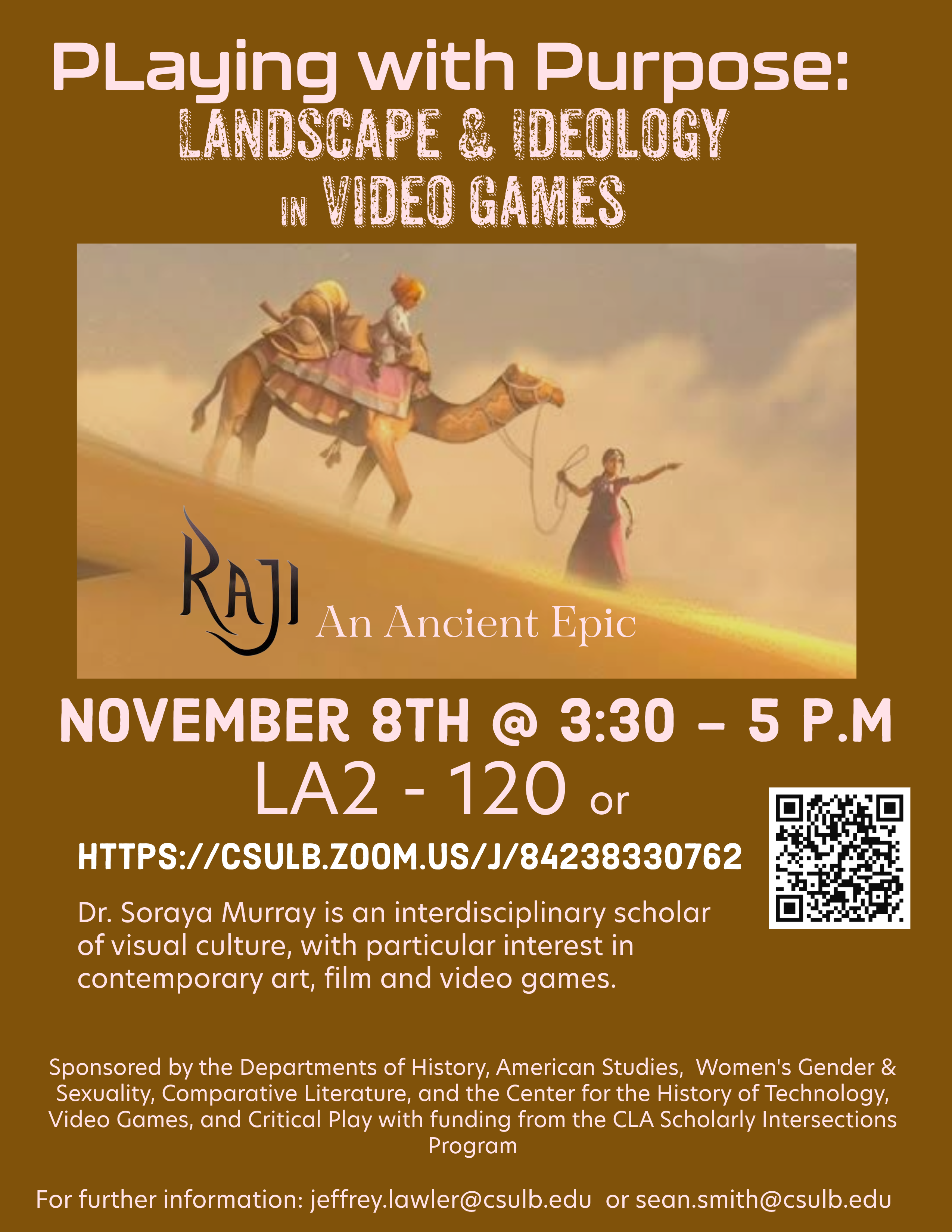
Thanks to my hosts, Jeffrey Lawler and Sean Smith, for their kind invitation to share my work with a new audience! The essay on which this talk was based (“Raji’s Burden”) will be out soon in CyberOrient.

Professor, Film + Digital Media at UC Santa Cruz / semurray[at]ucsc[dot]edu
Thanks to my hosts, Jeffrey Lawler and Sean Smith, for their kind invitation to share my work with a new audience! The essay on which this talk was based (“Raji’s Burden”) will be out soon in CyberOrient.

“Raji‘s Burden” in CyberOrient: Journal of the Virtual Middle East and Islamic World. Guest Editors: Souvik Mukherjee and Zahra Rizvi. Special Issue: Postcolonialism, Orientalism, and Video Games. NOW PUBLISHED! (December 2023) Special thanks to the editors for being included in this very special issue!

Abstract: Video games are enjoying a flourishing of critical studies; they are finally taken as consequential forms of visual culture worthy of historical, theoretical and cultural attention. At one time, their scholarship was largely overdetermined by issues of medium, and treated largely as an entertainment product. But with the complexifying of the form, combined with a new generation of dynamic scholars, and an expanded understanding of how to write about them, games now constitute a robust area of critical engagement with topics in race, sexuality, gender, ethnicity, ability, and other markers of difference.
Those interventions have been key in driving the discourse forward, but game studies now faces a new set of strategic challenges. The gains have likely come at great methodological cost. This essay explores the consequences of identity-focused analyses and the role of intersectional considerations of self and anti-essentialism as crucial tools in combatting enforced notions of belongingness. The author argues that the frontier of methodology in critical game studies may be to think outside of the prescribed ways in which academia encourages monolithic affiliation (or even false segregation) by validating and codifying identity-driven forms of expertise.
Keywords: representation; video games; videogames; belonging; anti-essentialism; game studies
 SORAYA MURRAY